
This content is provided for informational purposes only and does not constitute medical advice. Always consult a qualified healthcare professional or your GP before purchasing or taking any medication.
Why online medication purchases carry genuine health risks?
The scale of counterfeit medication circulation through unverified online channels has grown into a public health infrastructure problem. International health authorities estimate that a substantial proportion of medicines sold by illegal online sources are counterfeit, containing incorrect dosages, substituted ingredients, or no active pharmaceutical compound whatsoever. These are not marginal street-corner operations but sophisticated criminal networks operating professional-looking websites with international shipping logistics.
20
million doses
of illegally traded medicines seized by UK enforcement in 2025, worth £45 million
UK enforcement provides concrete evidence of this threat’s domestic impact. MHRA’s 2025 enforcement operations seized nearly 20 million doses of illegally traded medicines with a street value approaching £45 million, including 9.9 million sedative doses, 4.1 million painkiller doses, and 4.4 million erectile dysfunction medication doses.
INTERPOL’s Operation Pangea XVII, conducted across 90 countries between December 2024 and May 2025, seized 50.4 million illicit pharmaceutical doses worth $65 million, arrested 769 suspects, dismantled 123 criminal groups, and shut down approximately 13,000 websites marketing counterfeit medicines.
Counterfeit medications often contain heavy metal contaminants or incorrect dosages, creating life-threatening risks for patients. To mitigate these threats, it is vital to source treatments from a verified online pharmacy store. Legitimate providers operate under strict national and international oversight—such as the French Regional Health Agency (ARS)—ensuring that every dispensed product meets rigorous clinical standards and originates from a secure, legal supply chain.
The non-negotiable checks before placing any order
Verification of pharmacy legitimacy requires accessing official regulatory databases rather than relying on site-provided credentials. The General Pharmaceutical Council maintains a public register of all pharmacies legally permitted to operate in Great Britain, including those offering online services. This verification process takes under two minutes and provides definitive confirmation of regulatory compliance.
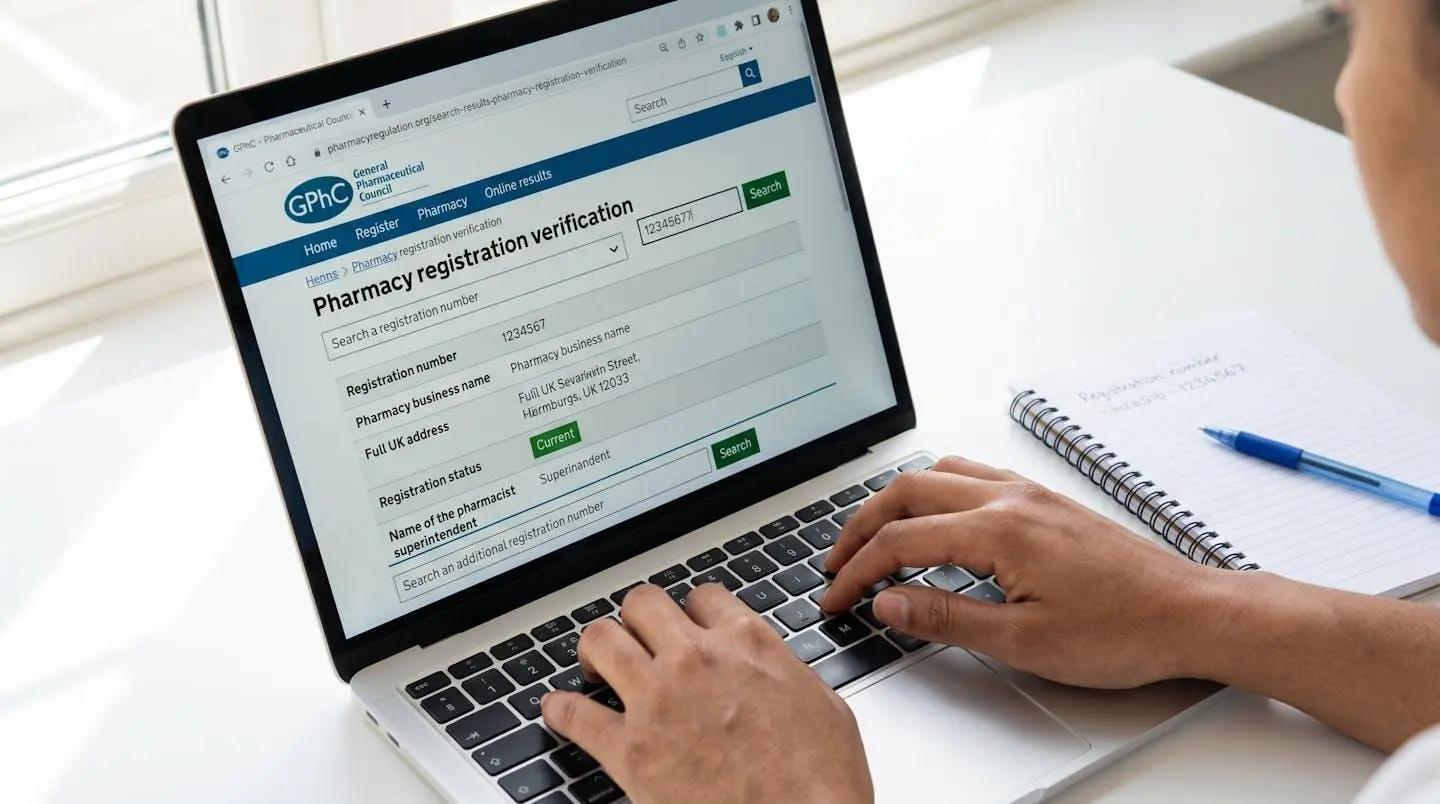
- Locate the GPhC registration number, typically displayed in the website footer, ‘About Us’ section, or legal information pages
- Navigate to pharmacyregulation.org and access the online register search function
- Enter the registration number exactly as displayed on the pharmacy website
- Verify the pharmacy business name matches precisely between the website and GPhC register entry
- Confirm the registration status shows ‘Current’ rather than suspended, removed, or expired
Verify the pharmacy registration number
UK pharmaceutical law requires all pharmacies providing online services to register with the GPhC and display their registration number prominently on their website. This number functions as a unique identifier linking the commercial website to the regulatory record. Legitimate pharmacies display this number voluntarily because it provides customer reassurance; fraudulent sites either omit it entirely or display fabricated numbers.
Access the register at pharmacyregulation.org, navigate to the pharmacy search function, and enter the registration number exactly as shown. The search results will display the registered pharmacy name, physical address, superintendent pharmacist details, and current registration status. Any discrepancy between the website’s claimed identity and the register entry is an immediate disqualification.
A common fraud tactic involves displaying a genuine GPhC registration number belonging to a completely different legitimate pharmacy. Criminals copy registration details from real pharmacies and display them on fraudulent sites, gambling that consumers will verify the number exists without checking whether the pharmacy name matches.
Confirm legitimate certification logos are genuine
Regulatory authorities have historically provided visual certification marks that legitimate online pharmacies could display. However, GPhC guidance updated in February 2025 discontinued the voluntary Internet Pharmacy Logo scheme as of 31 December 2025. Consumers should now rely exclusively on direct GPhC registration number verification through the online register rather than visual logo recognition.
This policy change simplifies verification whilst eliminating a common fraud vector. Counterfeit sites previously displayed convincing imitations of the official logo as non-interactive images. Criminals exploited this by creating pixel-perfect logo replicas that provided false reassurance.
If you encounter a site displaying what appears to be an official GPhC certification logo, treat it as decorative rather than verification. Focus verification effort on the registration number cross-check, which provides definitive regulatory confirmation that visual symbols cannot.
Test the accessibility of qualified pharmaceutical staff
GPhC standards require registered pharmacies to provide access to qualified pharmacist oversight for customer consultations. Legitimate online pharmacies display clear contact mechanisms including telephone numbers connecting to licensed pharmacists during stated operating hours, email addresses monitored by qualified staff, and often live chat functions with pharmaceutical professionals.
Test this accessibility before placing orders. Call the displayed telephone number during stated hours and verify you reach a pharmacy operation rather than a generic call centre. Ask a basic pharmaceutical question to confirm the responding staff member possesses professional knowledge. Fraudulent sites often list telephone numbers that connect to unrelated businesses or reach operators with no pharmaceutical training.
For prescription-only medicines, UK law mandates verification of valid prescriptions before dispensing. Legitimate pharmacies implement robust prescription verification protocols, contacting your GP surgery to confirm prescription details or requiring you to post original prescription documents. Any site offering to sell prescription-only medications without prescription verification is operating illegally.
Red flags that indicate fraudulent pharmaceutical sites
Enforcement data from regulatory agencies reveals consistent patterns distinguishing fraudulent pharmacy operations from legitimate providers. These patterns function as early warning signals, often visible within seconds of landing on a site.
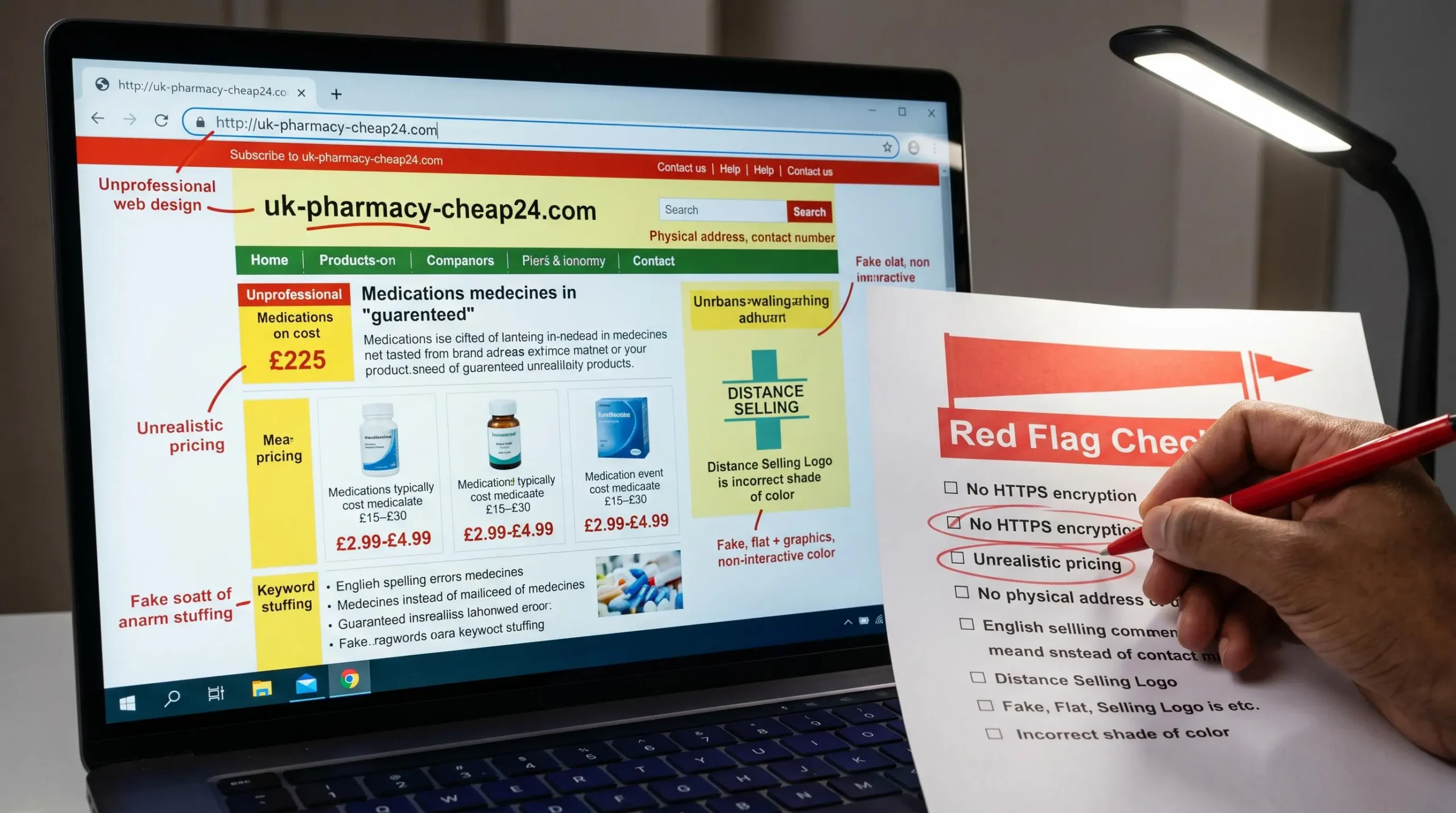
- Domain name manipulation – sites using slight misspellings of established pharmacy names or keyword-stuffed domains like « uk-meds-cheap-online-pharmacy-24.com » rather than professional business names
- Absent HTTPS encryption – browser address bar displaying « http:// » without the padlock icon indicating secure connection (all legitimate pharmacies handling medical and payment data use HTTPS as mandatory minimum)
- Pricing drastically below market rates – medications offered at 60-80% below typical UK pharmacy pricing without credible explanation (legitimate pharmacies operate on regulated margins and cannot sustainably undercut market rates by extreme percentages)
- No physical address or vague location claims – sites claiming « UK-based » without providing verifiable street address, or listing only PO boxes and email contact with no telephone number
- Prescription medications offered without verification – sites selling prescription-only medicines with no prescription upload requirement or only perfunctory questionnaires replacing legitimate medical consultation
- Poor English with spelling and grammar errors – professional pharmacy sites employ qualified copywriters; persistent errors in product descriptions, terms and conditions, or customer communications indicate non-professional operation
Most convincing fraud tactic targeting UK consumers: Fraudulent operators increasingly use domain names with minor variations of legitimate pharmacy chains—for example, « boots-pharmacy-uk.com » instead of the authentic « boots.com ». These typosquatting domains display professional designs copied directly from genuine pharmacy websites, complete with fake certification graphics. Always verify the exact domain matches the pharmacy’s official web address before entering any personal information.
Regulatory authorities recommend treating any combination of three or more warning signs as definitive disqualification. Sophisticated fraud operations have learned to address obvious single warning signs whilst leaving others unresolved.
Consider a documented enforcement case pattern: a fraudulent site operated under domain « boots-online-pharmacy-uk.com », displaying professional design copied from legitimate branding, listing medications at 40% below market rates, and showing fabricated GPhC number 9847362. The site accepted prescription medication orders with only a brief questionnaire, no GP verification. Consumers who performed GPhC register verification discovered the registration number belonged to a completely different Leicester-based pharmacy. Within 48 hours of MHRA notification, the domain was suspended, but operators had already processed 340 orders collecting payment and medical data whilst shipping no actual medications.
Protecting your personal and financial data during purchase
Online medication purchases require transmitting sensitive medical history, current health conditions, prescription details, and payment information. UK GDPR legislation imposes strict requirements on how pharmacies collect, store, and process this health data. Legitimate pharmacies implement comprehensive data protection protocols; fraudulent sites exploit medical data for identity theft and financial fraud.
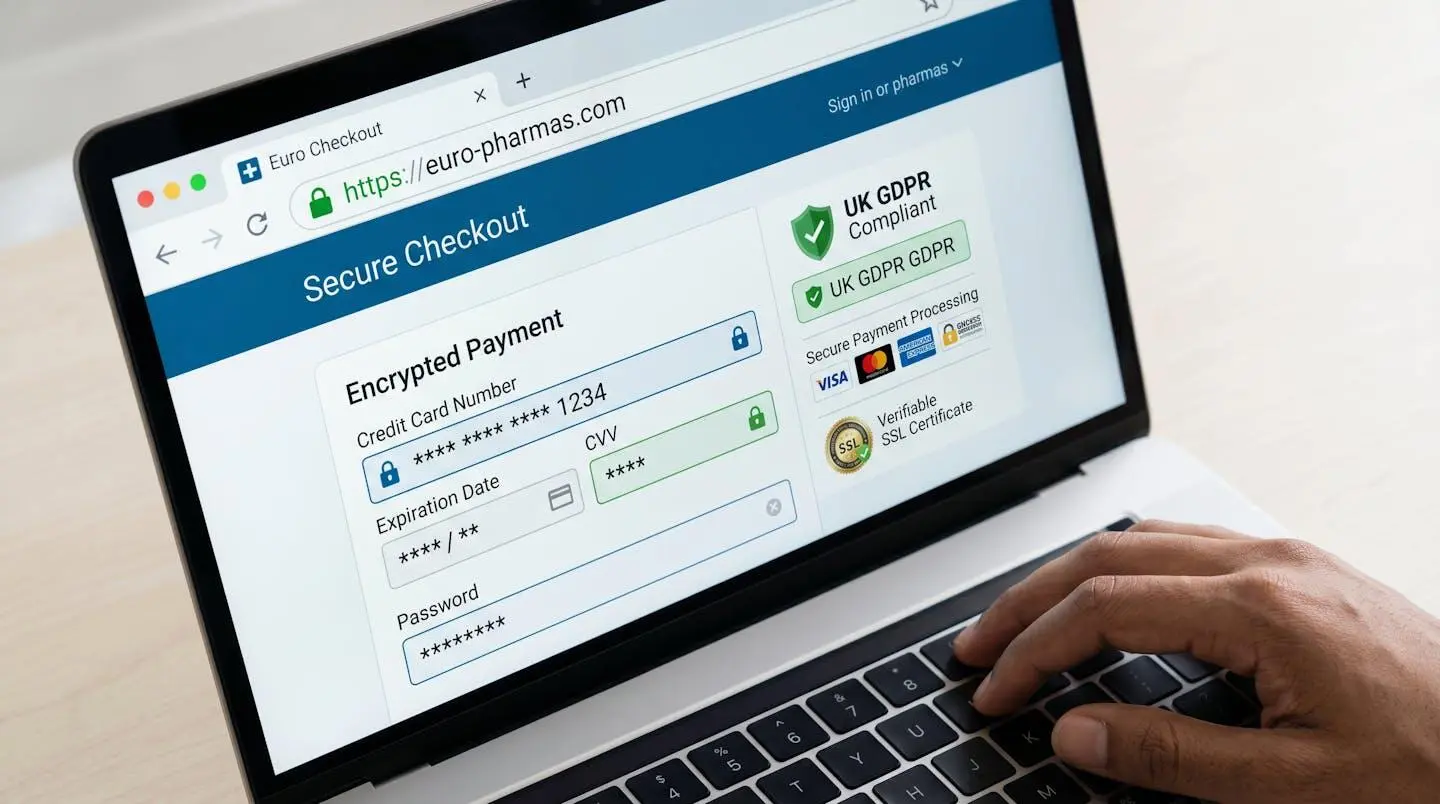
The browser address bar provides the first data security checkpoint. Verify the URL begins with « https:// » and displays a padlock icon before the domain name. This indicates SSL/TLS encryption is active, meaning data transmitted between your browser and the pharmacy’s servers is encrypted. The absence of HTTPS is an absolute disqualification for any site requesting medical or payment information.
Evidence-based practice suggests examining the site’s privacy policy and data protection documentation before purchase. Legitimate pharmacies provide detailed, specific information about data retention periods, purposes for processing medical information, third-party sharing policies, and your rights under UK GDPR including access, correction, and deletion requests. Fraudulent sites either omit privacy policies entirely or provide vague, generic text clearly copied from templates without customisation to the specific pharmacy’s actual practices.
Evaluating data protection compliance requires examining concrete implementation rather than relying on decorative badges. Legitimate international operations demonstrate measurable security standards through published GDPR compliance documentation and encrypted payment infrastructure. These providers implement multilingual customer data protocols that meet both UK and EU regulatory requirements, serving as a benchmark for safety. Such transparent practices allow patients to distinguish between professional healthcare services and fraudulent operations that exploit sensitive medical information for identity theft.
Pro tip: Use payment methods offering purchase protection and dispute resolution mechanisms. Credit cards and PayPal provide chargeback procedures enabling you to contest fraudulent charges and recover funds if you receive counterfeit medications or nothing at all. Avoid wire transfers, cryptocurrency payments, or prepaid debit cards when purchasing medications online, as these payment methods offer no recourse if the transaction proves fraudulent.
Examine how the pharmacy requests and verifies prescription information for prescription-only medications. Legitimate operations implement secure prescription upload portals using encrypted file transmission, or contact your GP surgery directly to verify prescription details. Sites requesting you email prescription photographs to generic addresses, or accepting prescriptions without contacting your GP for verification, fail to meet regulatory standards for prescription validation.
Frequently asked questions about online medication safety
Can I legally purchase prescription medications online without seeing my GP in person?
UK pharmaceutical law requires valid prescription verification for all prescription-only medicines. You cannot legally purchase these medications without a prescription, but you do not necessarily need an in-person GP appointment. Legitimate online pharmacies either verify existing prescriptions by contacting your GP surgery directly, or offer regulated online consultation services with qualified prescribers who can issue prescriptions following proper medical assessment.
What distinguishes UK and EU online pharmacies following Brexit, and which can I safely use?
UK online pharmacies now operate exclusively under MHRA jurisdiction, whilst EU pharmacies fall under European Medicines Agency oversight. Post-Brexit, these regulatory frameworks no longer automatically recognise each other’s certifications. For UK residents, verify any pharmacy selling to you holds current GPhC registration regardless of where it is physically based.
What immediate steps should I take if I have already purchased from a suspicious pharmacy website?
Do not take the medication. Contact your GP immediately if you have already taken any doses, bringing the packaging and remaining medication for examination. Report the site to the MHRA through their online reporting system. If you paid by credit card or PayPal, initiate a chargeback dispute through your payment provider to attempt fund recovery.
Are online pharmacies appropriate for managing chronic conditions requiring regular prescriptions?
GPhC-registered online pharmacies often provide excellent services for repeat prescription management of chronic conditions including diabetes, hypertension, asthma, and cardiac disease. Many offer automated prescription renewal reminders, coordination with GP surgeries for prescription updates, and convenient delivery scheduling. The critical requirement is ensuring the pharmacy maintains proper GP communication and qualified pharmacist oversight.
Rather than wondering whether the website looks professional enough to trust, ask whether you have verified its GPhC registration number through the official register in the past six months. Professional web design costs a few thousand pounds; legitimate pharmaceutical regulatory compliance requires sustained operational standards, qualified staff, inspectable premises, and accountability to enforcement authorities. Only one of these is verifiable through independent official databases within two minutes.
Scope limitations: This guide provides general safety principles for verifying UK online pharmacy legitimacy but cannot guarantee the authenticity of any specific website. Pharmaceutical regulations vary significantly between countries. Certain medications require mandatory face-to-face consultation. This information does not replace direct verification with official regulatory bodies before making purchase decisions.
Health and financial risks: Purchasing from unverified sources may result in receiving counterfeit, contaminated, or therapeutically ineffective medications posing serious health consequences. Sharing medical and financial data on fraudulent sites exposes you to identity theft and financial fraud.
Professional guidance: Consult the General Pharmaceutical Council directly for definitive verification of any pharmacy’s registration status, or contact your GP for guidance on appropriate sources for prescription medication needs. For suspected counterfeit medications or adverse reactions, report immediately to the MHRA Yellow Card scheme and seek medical assessment.